Submission timeline
2007–2026One slot for every year since HN launched. Height is that year's peak points; orange marks a 100+ point or 50+ comment breakout. Select a bar to open its strongest thread.
Top comments
Finally read this paper a couple of days ago. Even though i thought i already understood the concepts of higher order functions and laziness, and had used them on my every-day programming, the paper was still quite enlightening. One of the things i hadn't considered before is how much laziness can help to build modular code. The last section in the paper, about implementing the minimax algorithm, is a great example of this. The `evaluate` function is first naively defined…
If anyone is looking for a really eye-opening video take a look at that this. "Domain Modeling Made Functional" It's applying Functional Programming to plain old Enterprise line of business apps in F#. The author argues why it's so much simpler, and simply walks through an example with cases. It's hard not to be persuaded. It leaves behind all of the lofty crazy maths you see in a lot of presentations of FP, and just shows how it's a simpler…
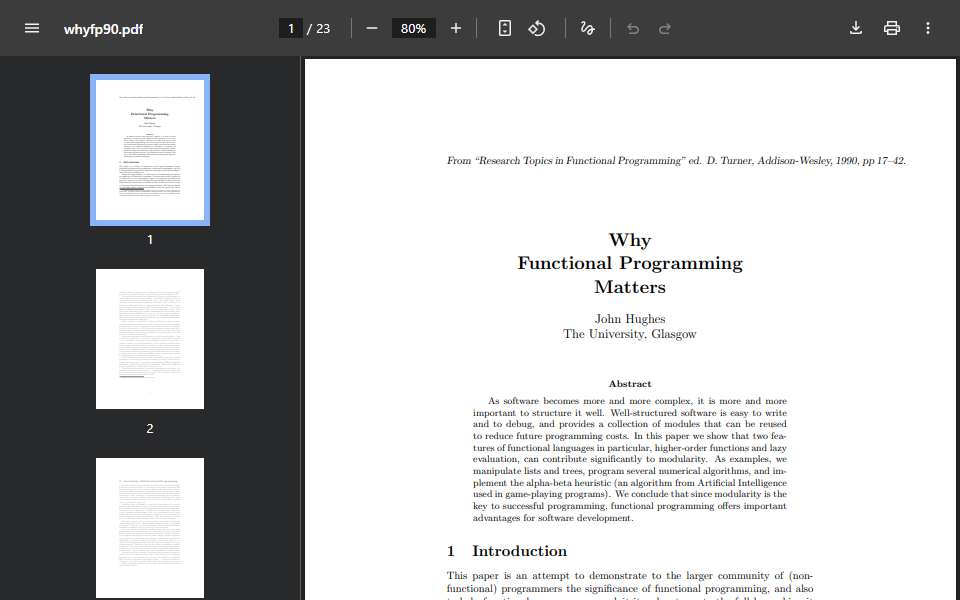
> As software becomes more and more complex, it is more and more important to structure it well. Well-structured software is easy to write and to debug, and provides a collection of modules that can be reused to reduce future programming costs. In this paper we show that two features of functional languages in particular ... My problem with this side of the force, is that it's all about the theory and the expressivity, which matters of course, but very…
Hot take: this is a classic paper, but didn't it turn out to be mostly wrong about why functional programming matters? Most of the motivating examples rely on lazy evaluation, which is pretty much the only idea from ML/Miranda/Haskell which has not seen adoption within modern mainstream programming languages. So while the motivating examples are very well done, it seems empirically that the main value of the functional approach lies elsewhere.
The first top-level comment from each of the four biggest threads, in HN’s own order. Excerpts are shortened; open a comment for full context.
HN stats
- Breakout years
- 2
- Total points
- 265
- Total comments
- 250
100+ points or 50+ comments
reference only — not used in Hall rules or ranking
reference only — not used in Hall rules or ranking
Every submission
| Date | Title as submitted | By | Points | Comments |
|---|---|---|---|---|
| 2014-06-30 | Why functional programming matters [pdf] | charles_dickens | 2 | 0 |
| 2014-10-22 | Why Functional Programming Matters (1989) [pdf] | ironchief | 5 | 0 |
| 2015-05-06 | Why functional programming matters (1990) [pdf]First breakout · Best thread | znt | 113 | 139 |
| 2018-09-08 | Why Functional Programming Matters (1990) [pdf] | tosh | 4 | 0 |
| 2019-01-20 | Functional Programming Matters( 1990) [pdf] | philonoist | 1 | 0 |
| 2019-11-08 | Why functional programming matters (1990) [pdf]Hall induction | palerdot | 102 | 103 |
| 2022-01-15 | Why Functional Programming Matters [pdf] | mwattsun | 3 | 1 |
| 2023-05-19 | Why Functional Programming Matters (1990) [pdf] | alokrai | 3 | 0 |
| 2023-12-07 | Why Functional Programming Matters [pdf] | saikatsg | 5 | 2 |
| 2024-05-22 | Why Functional Programming Matters [pdf]Latest 20+ point return | alexzeitler | 27 | 5 |