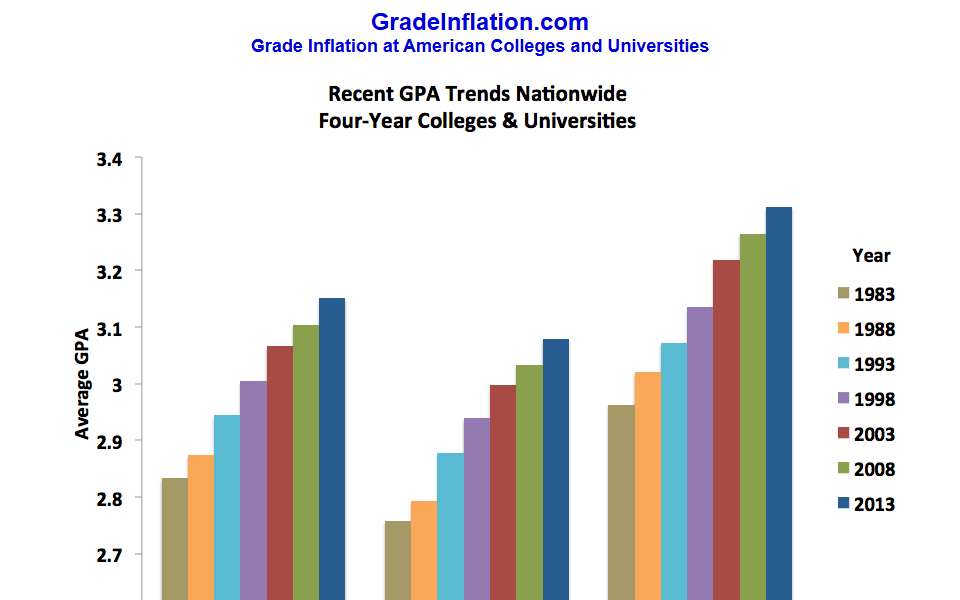
Grade Inflation at American Colleges and Universities
Report a link problem
Submission timeline
2007–2026One slot for every year since HN launched. Height is that year's peak points; orange marks a 100+ point or 50+ comment breakout. Select a bar to open its strongest thread.
Top comments
One possible cause not mentioned in the article is that universities offer/require more filler courses. Last year, for example, I had to teach an intro to HTML course at a UC school. This is a required course for all non-engineering majors. To get an A, all you have to do is create a single html webpage using 10 different tags and 10 different css styles.[1] These courses are huge money makers for the university. I had 120 students in the…
I don't live in the US and I didn't go to college in the US, so my experience is largely irrelevant to the topic. But in my own country (Italy), even though grade inflation is a thing both in high schools and universities, I see something here that is in stark contrast with some statements in the article: italian students definitely study a lot, far more than in the 60s/70s/80s. In those times the university, although useful, was seen "just…
I went to Saint Anselm College in New Hampshire. It's a liberal arts college with about 2,000 students. They explain to all the incoming freshmen (and their parents!) that they don't do grade inflation. An average student is a "C" student. The bookstore sells t-shirts with "C+ Better than Average!"
The most important line in the paper: "As a rough rule of thumb, the average GPA of a school today can be estimated by the rejection percentage of its applicant pool: GPA = 2.8 + Rejection Percentage /200 + (if the school is private add 0.2)" Interesting the more students a school rejects the higher its GPA seems to be. To say it another way, the more selective an institution is the higher the GPAs. ie. If you get smarter…
The first top-level comment from each of the four biggest threads, in HN’s own order. Excerpts are shortened; open a comment for full context.
HN stats
- Breakout years
- 2
- Total points
- 176
- Total comments
- 227
100+ points or 50+ comments
reference only — not used in Hall rules or ranking
reference only — not used in Hall rules or ranking
Every submission
| Date | Title as submitted | By | Points | Comments |
|---|---|---|---|---|
| 2009-03-25 | National Trends in Grade Inflation, American Colleges and Universities | tokenadult | 1 | 0 |
| 2010-04-20 | Recent trends in grade inflation at American universities | ajdecon | 20 | 36 |
| 2010-10-29 | Grade Inflation at American Colleges and Universities | aycangulez | 27 | 31 |
| 2015-05-14 | Grade Inflation at American Colleges and UniversitiesFirst breakout · Best thread | bane | 70 | 99 |
| 2018-11-14 | Grade Inflation at American Colleges and Universities | hellrich | 3 | 0 |
| 2020-08-14 | Grade Inflation at American Colleges and UniversitiesLatest 20+ point return | Reedx | 55 | 61 |