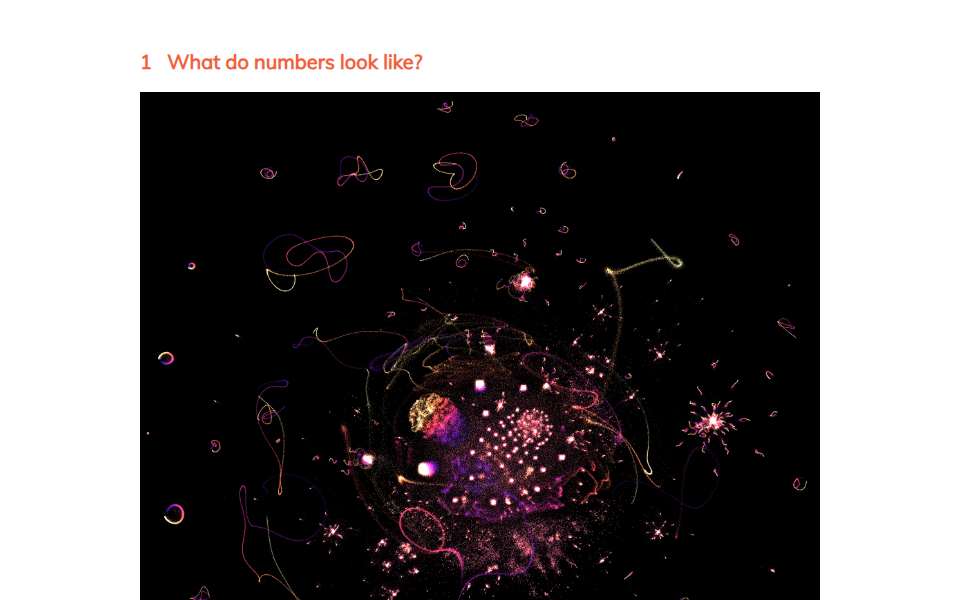
A visualization of the prime factors of the first million integers
Report a link problem
Submission timeline
2007–2026One slot for every year since HN launched. Height is that year's peak points; orange marks a 100+ point or 50+ comment breakout. Select a bar to open its strongest thread.
Top comments
> A very pretty structure emerges; this might be spurious in that it captures more about the layout algorithm than any "true" structure of numbers. What would it look like if we used PCA rather than UMAP? PCA is simpler than UMAP, so it's in some sense "less arbitrary". If the image is similar then we know we're seeing something about numbers rather than about our methods.
According to Dmitry Kobak, some details in these figures are merely convergence artifacts, and no longer produced when using more recent versions of UMAP. https://twitter.com/hippopedoid/status/1318917878364672001?l...
The first top-level comment from each of the four biggest threads, in HN’s own order. Excerpts are shortened; open a comment for full context.
HN stats
- Breakout years
- 2
- Total points
- 656
- Total comments
- 112
100+ points or 50+ comments
reference only — not used in Hall rules or ranking
reference only — not used in Hall rules or ranking
Every submission
| Date | Title as submitted | By | Points | Comments |
|---|---|---|---|---|
| 2018-08-22 | A visualization of the prime factors of the first million integersFirst breakout · Best thread | fanf2 | 438 | 59 |
| 2020-10-08 | What do numbers look like? | frisco | 3 | 0 |
| 2022-11-13 | What do numbers look like?Latest 20+ point return | xqcgrek2 | 213 | 53 |
| 2024-11-12 | What do numbers look like? | metadat | 2 | 0 |